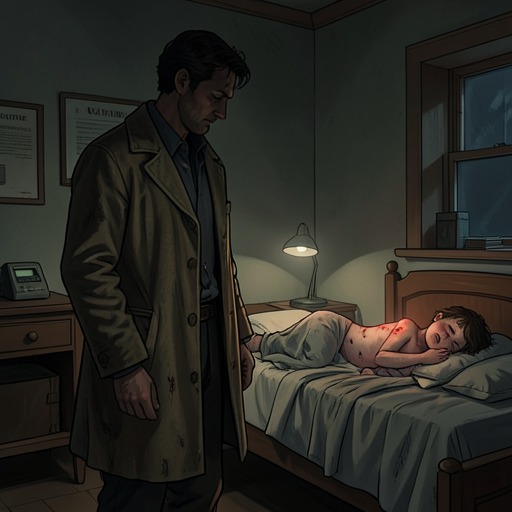
Philip's homelessness
Of Human BondagePhilip Carey’s homelessness is a short, concealed crisis rather than a settled way of life: after going a week without returning to his rooms, he tells Thorpe Athelny that he has been sleeping nowhere. Shame makes the admission difficult, but Athelny answers with recognition rather than reproach and takes him in. The episode turns homelessness into a measure of both material insecurity and the difficulty Philip has in asking for help; it also gives friendship a concrete form, a place to sleep and a home until he can find work.
Circumstances and Earlier Isolation
Homelessness arrives against a longer history of feeling exposed and out of place. At school, a younger boy notices Philip’s club foot and asks what is wrong with it. Philip instinctively hides the affected foot behind the sound one before answering. The moment is not itself a cause of his later homelessness, but it establishes an early pattern: bodily difference attracts attention, and Philip responds by trying to manage what others see.
That self-consciousness continues in his relations with other boys. When Philip is placed in a study whose occupants have already been together for three terms, they welcome him coldly. He conceals his nervousness by keeping quiet, and even when Rose invites him to walk to the football field, Philip worries that his club foot will prevent him from keeping pace. Rose’s kindness draws him into the group, but the episode shows how social inclusion can depend on another person making the first move.
The same difficulty follows him into medical school. Philip desires popularity but fears rebuff and hides his shyness beneath a reserved manner. He makes acquaintances without becoming intimate with them. His friendship with Dunsford develops largely because Dunsford attaches himself to the first person he knows at St. Luke’s; their Saturday visits to a music hall pit or theatre gallery offer companionship, though Philip often treats his friend as a butt. These earlier relationships illuminate the particular obstacle Athelny must overcome: Philip is not simply short of money or shelter; he is reluctant to expose need and depend on another person.
Work, Care, and Material Precarity
Philip’s medical training gives him sustained contact with people whose lives are shaped by illness and poverty. As an out-patients’ clerk at St. Luke’s Hospital, he works among crowded rooms and long rows of patients waiting with bottles and medicine jars. Their ailments and circumstances make suffering immediate rather than abstract. The experience also changes his sense of vocation: compared with the effort to make beautiful things in Paris, contact with patients gives him a direct feeling of engagement and power.
That work does not make Philip immune to insecurity. In the weeks leading up to the crisis with Athelny, his landlady reports that he has not been in since Saturday night and owes her for the last month. Asked where he has slept during the week, he answers, “Nowhere.” The debt and absence make the situation concrete: he has lost the practical security of a room and has not arranged an alternative. Yet he has kept this from the people who might help, so the privation is compounded by secrecy.
The novel also places Philip’s medical life beside the precarious conditions he encounters among the poor. In his district duties he attends confinements at all hours, walking through deserted streets to crowded, badly maintained homes. In one such case, a woman dies after childbirth, leaving her husband bewildered beside the bed; he explains that there is nowhere for him to lie down. This is not Philip’s own homelessness, but it sharpens the context of the episode: the absence of shelter appears as a material fact in working people’s lives, not merely an inward metaphor for loneliness.
Discovery and Athelny’s Intervention
Athelny discovers Philip’s circumstances by looking for him. He had written to ask whether anything was wrong, then visited Philip’s rooms when no answer came. The landlady’s account of the unpaid rent and Philip’s prolonged absence gives him reason to ask directly where Philip has been sleeping. Philip turns his head away, stares out of the window, and finds it sickening to answer. The plainness of “Nowhere” breaks through the concealment without making the confession easy.
Athelny does not treat the admission as evidence of foolishness or moral failure. He explains that he and Betty had also been broke in their day, though they had babies to look after, and asks why Philip did not come to them. Philip says he could not. That brief exchange reveals the distance between available help and help actually sought: Athelny’s household is not a resource Philip feels entitled to use, and his shame persists even when a friend has already come looking for him.
Once Philip has told the story of the preceding weeks, Athelny gives the crisis an immediate practical answer: Philip is to live with the family until he finds something to do. The offer changes homelessness from an undisclosed condition into a problem met by hospitality. It does not erase Philip’s difficulty in accepting care—he flushes after Athelny’s decision—but it gives him a secure place from which he can begin again.
The Crisis’s Emotional Frame
The discovery takes place during a meal in the Athelnys’ comfortable house, and the contrast makes shelter newly visible to Philip. He has thought himself ravenous, but when he begins to eat his stomach turns against food. His mind is exhausted; from time to time he looks out at the storm, the cold, and rain striking the window, knowing that after ten o’clock he cannot stay in the house. The weather lends urgency to a fear that is already practical: he does not know where he will spend the night.
Being indoors with friends intensifies rather than immediately relieves that fear. Philip thinks of the many people who will be outside, tries to distract himself by talking, and starts when rain hits the window. The scene therefore resists a simple division between safe interior and dangerous street: the house makes shelter possible, but its comfort also forces him to confront how little shelter he possesses. Athelny’s later discovery converts that contrast into an act of care, while Philip’s silence and shame show why such care had not been requested sooner.
Significance
The episode gathers several recurring features of Philip’s life—fear of rejection, difficulty making advances toward others, and vulnerability to material reversals—into a crisis that can be answered by a relationship. Earlier, Rose drew him into a schoolboy circle and Dunsford attached himself to him at medical school; now Athelny actively seeks him out when he disappears. The difference is significant: Philip’s need is not solved by self-sufficiency, but by someone noticing his absence and refusing to leave the matter unspoken.
Homelessness also brings Philip’s private distress into contact with the poverty he encounters professionally. His work has taught him to listen to patients and to earn confidence without condescension; the exchange with Athelny makes him, in turn, the person whose concealed need must be heard. The resolution is modest and specific—a place in the Athelny home until he finds work—but that material provision is precisely what makes the friendship consequential. The crisis ends not with a general cure for Philip’s insecurity, but with temporary shelter and the possibility of a next step.